AI Data Center Power Testing: How to Validate Megawatt-Scale Infrastructure
The AI data center boom is rewriting the rules of power delivery. Racks that once drew 15-20 kW now routinely exceed 100 kW — some GPU racks already draw 120-140 kW — and 1 MW rack designs have already been shown at industry events. Every stage of that power path — from the utility feed down to the GPU — has to be validated before it goes into production. This guide covers what AI data center power testing actually involves, why conventional test methods fall short at this scale, and which AC/DC power sources, electronic loads, and grid simulators make it practical.
What Is AI Data Center Power Testing?
AI data center power testing is the use of programmable AC and DC power sources, electronic loads, and grid simulators to validate the performance, reliability, efficiency, and safety of the power infrastructure feeding AI compute clusters — including utility-facing equipment (transformers, UPS, PDUs, automatic transfer switches), rack-level power shelves and bus converters, and the power supply units and DC-DC converters that ultimately feed GPUs and accelerators. Because AI workloads create fast, large power swings, this testing has to reproduce real-world transients and fault conditions, not just steady-state loads.
Why AI Racks Are Rewriting the Power Delivery Playbook
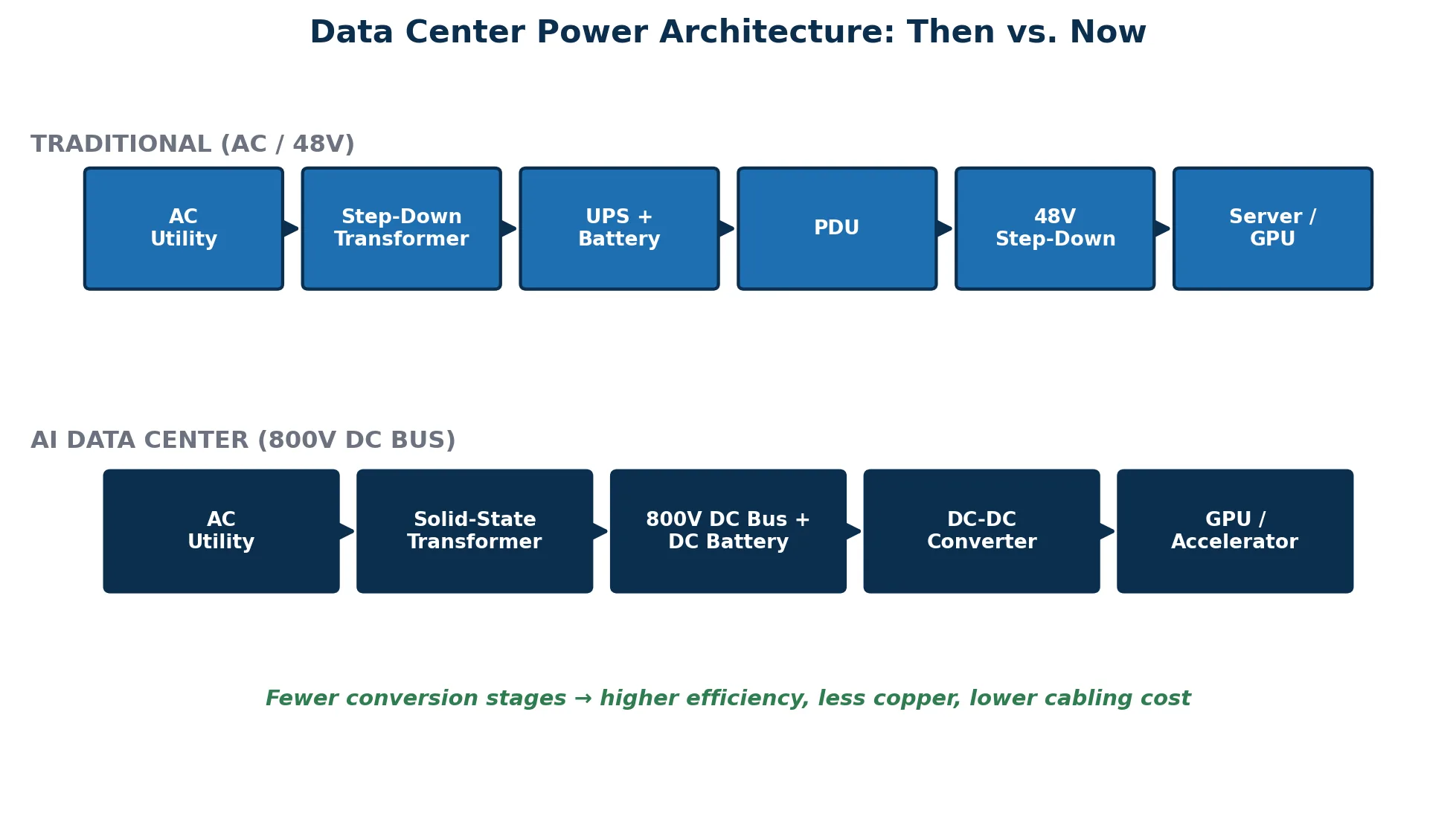
A traditional data center power path looks like this: AC utility input feeds transformers that step down voltage, large UPS systems with battery backup provide ride-through, diesel generators and automatic transfer switches handle outages, and power distribution units carry AC to the rack, where it is stepped down to 48V for the individual servers.
AI infrastructure is compressing that path. Many new designs bring AC in through solid-state transformers (SSTs) that convert directly to an 800V DC bus — with DC-coupled battery backup — and step that 800V down close to the point of load, largely bypassing the traditional 48V stage. Fewer conversion stages means higher efficiency, less copper, and lower cabling costs at scale. It also means every one of those new components — AC-DC and DC-DC converters, solid-state transformers, circuit breakers, and ATS switches — needs its own validation program before it can be trusted at megawatt scale.
What Engineers Are Actually Testing For
At the R&D stage, testing centers on performance: does the design hit its specs? As a product moves through evaluation, the focus shifts to safety compliance and long-term reliability — confirming the equipment can run in an AI facility for years without failure. In practice, it’s rarely just one of these; production-grade test programs validate performance, reliability, safety, and compliance together.
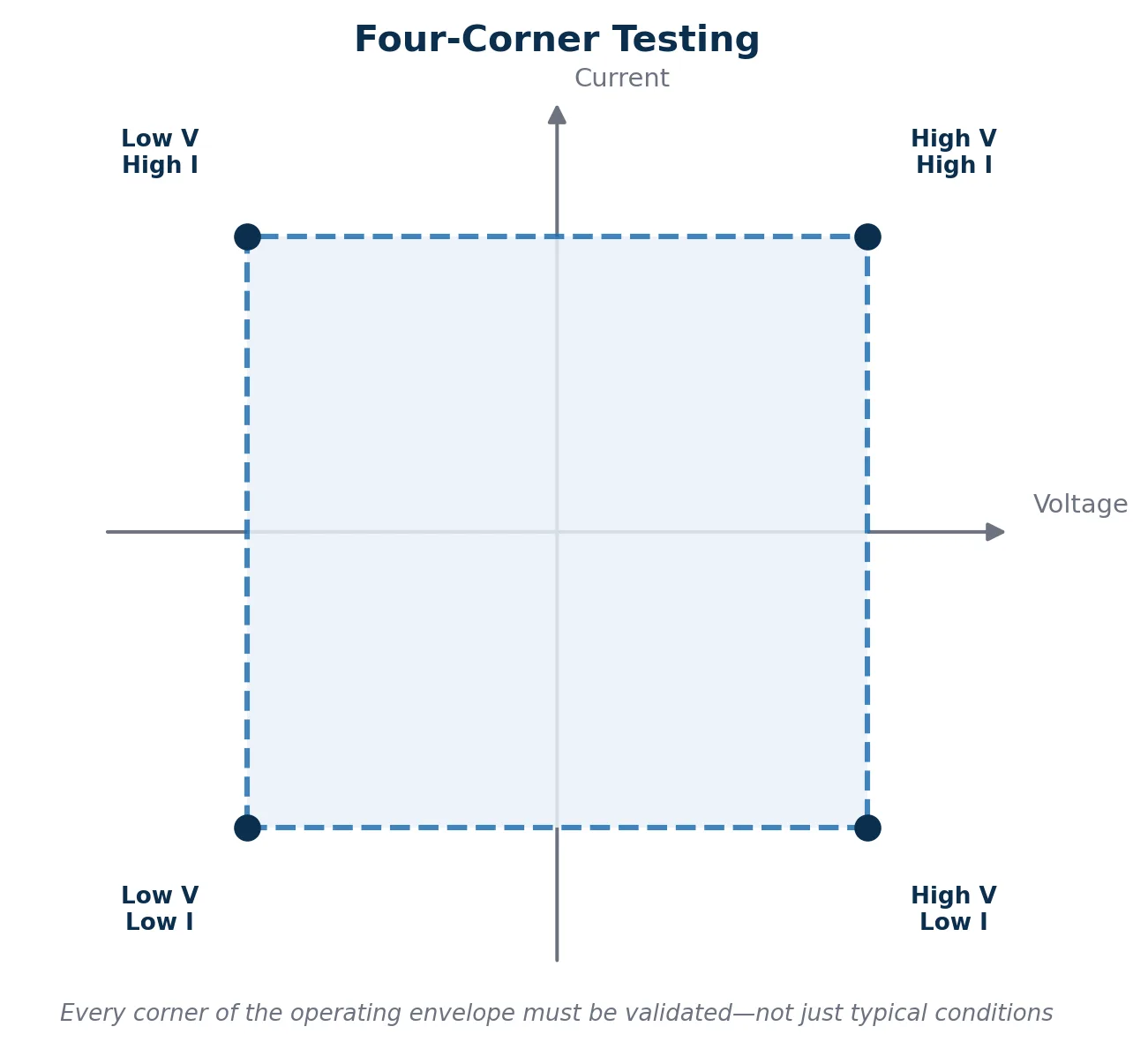
A core part of that validation is four-corner testing: high voltage, high current, low voltage, and low current combinations, run with precise, repeatable control. Utility power can’t do this — its faults are unpredictable and inconsistent. Programmable AC/DC power sources let engineers set exact conditions, reproduce them on demand, and inject controlled fault events (voltage sags, surges, frequency shifts) to confirm equipment survives — and recovers from — grid disturbances without cascading failures.
Simulating GPU Load Transients: Why Response Speed Matters
GPU clusters ramp power up and down far faster than legacy IT loads. On the low-voltage, high-current side of the GPU, DC-DC converters have to respond to load steps in milliseconds using switching electronic loads — but validating the converter’s control loop under realistic conditions increasingly requires linear electronic loads capable of 20-30 microsecond response, with some requirements pushing into the nanosecond range. Test equipment that can’t keep up with these transients will pass designs that fail in production.
The Megawatt Burn-In Problem — and How Regenerative Test Systems Solve It
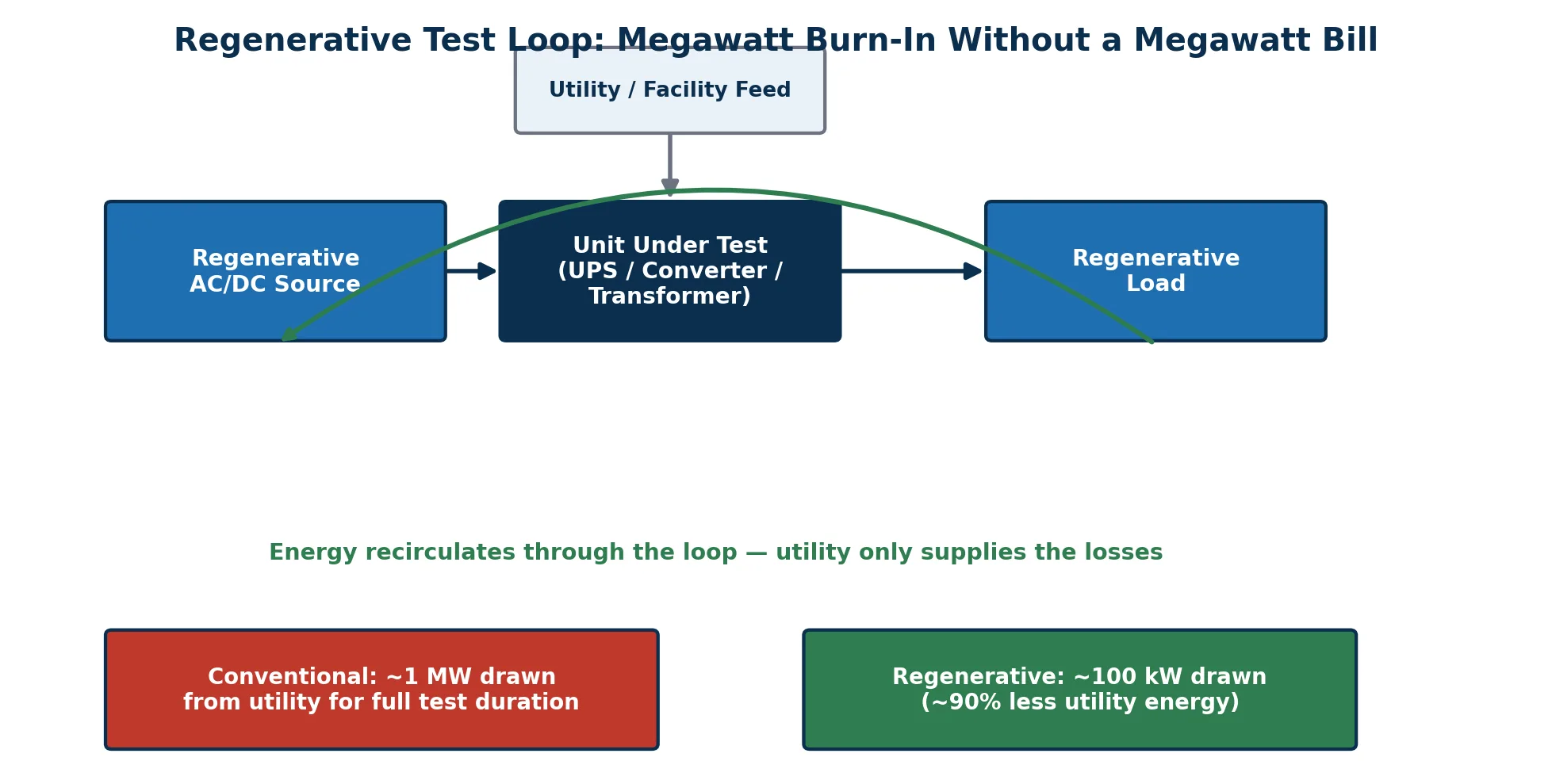
Burn-in testing exists because a large share of power product failures (“infant mortality”) surface early in operation, before long-term wear-out failures appear — the classic reliability “bathtub curve.” As PPST’s Mike Nolan noted in a recent interview, that dynamic is a major reason burn-in matters so much for AI power equipment. Published burn-in durations vary widely by industry, from roughly 24-48 hours for consumer-grade equipment up to 500+ hours for aerospace- and military-grade products — but at megawatt scale, even a shorter burn-in run the conventional way means drawing hundreds of kilowatts to a full megawatt from the utility for the duration of the test. That’s an enormous energy bill, especially under time-of-use rates in markets like California, and a significant heat load that drives up cooling costs and can create uncomfortable, non-compliant working conditions.
Regenerative test systems solve this by closing the loop: energy flows through the unit under test and into a matching regenerative source or load, which feeds the energy back to the facility or grid instead of dissipating it as heat. In a back-to-back configuration, the utility only has to supply the combined losses of the two energy conversion devices and the unit under test — typically under 10% of the total power. A test that would otherwise draw a full megawatt from the grid can draw roughly 100 kW instead: about a 90% reduction in energy consumption and cost, with a proportional drop in cooling load. Pacific Power Source’s own published testing on a 10 kW / 10-hour burn-in example shows an even larger total energy reduction (over 90%) once HVAC load is factored in.
Scaling From a Single Rack to a Full Data Center
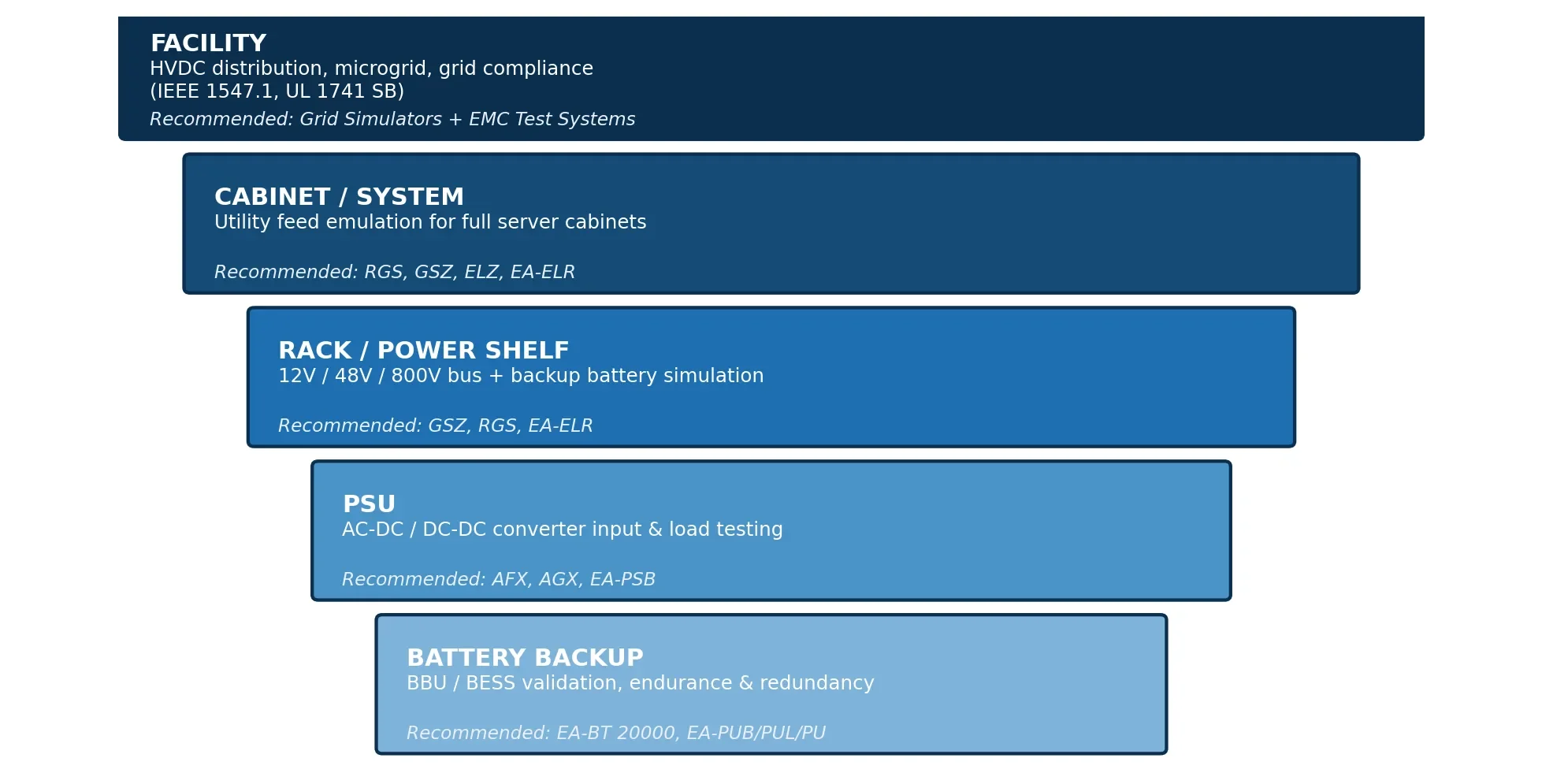
There’s no single test configuration that covers every data center. Facilities today run anywhere from legacy 10 kW racks to 100 kW+ deployments, with 1 MW racks already demonstrated at industry events. The practical answer is modular test architecture: AC and DC power sources, loads, and grid simulators that scale in parallel or series –– from a few kilowatts up to multi-megawatt AC, and from a few kilowatts up to multi-megawatt DC sourcing or sinking — so the same platform validates a single power shelf or an entire cabinet without a redesign of the test setup.
Testing at the Facility Level: HVDC, Microgrids, and Distributed Generation
The utility grid alone can’t scale fast enough to meet gigawatt-class AI facility demand, which is why data centers are increasingly pairing utility feed with fuel cells, small modular nuclear, and on-site energy storage. The shift to 800V DC distribution — enabled by power components that matured in 800V automotive platforms, and now being standardized through efforts like the Open Compute Project and NVIDIA’s 800 VDC architecture initiative — removes conversion stages, increases efficiency, and cuts cabling costs.
All of it needs facility-level validation: HVDC distribution and converter/rectifier testing, battery energy storage and UPS/PDU validation, and grid-compliance testing (IEEE 1547.1, UL 1741 SB, EN 50549) for any equipment that can source power back to the grid, including anti-islanding behavior when utility power drops.
Choosing the Right AI Data Center Power Test Solution
PPST Solutions brings that into a single source for AI data center power validation:
- Regenerative AC/DC power sources and grid simulators (AGX, AZX, RGS, GSZ Series) that scale from a few kVA to 1.296 MVA+, with >90% energy efficiency
- Regenerative AC electronic loads ; DC electronic loads (RLS, ELZ, EA-ELR Series) built for the fast transients of GPU cluster testing, including linear response for microsecond-class load steps
- Bidirectional DC power and battery test systems (EA-PSB, EA-PUB/PUL/PU, EA-BT Series) for HVDC bus, energy storage, and battery backup validation up to 3.84 MW
- EMC systems for harmonics, flicker, and immunity testing
- Grid-compliance test systems for interconnection standards (IEEE 1547.1, UL 1741 SB)
The result is a modular test platform that scales from a single PSU on a bench to a full megawatt-class rack or facility validation program — without switching vendors between the AC side, the DC side, and the loads.
Frequently Asked Questions
What equipment do I need to test AI data center power systems?
A complete AI data center power test setup typically includes a programmable AC and/or DC power source (to emulate the utility or DC bus feed), a regenerative AC/DC electronic load (to simulate rack, GPU, or cluster demand), and, for facility- or cabinet-level work, a regenerative grid simulator that can emulate utility faults and support grid-compliance testing.
What is a regenerative electronic load, and why does it matter for burn-in testing?
A regenerative electronic load absorbs the energy from a unit under test and feeds it back to the facility or grid instead of dissipating it as heat. For megawatt-scale burn-in testing, this can cut utility energy draw by roughly 90 percent, since the grid only has to supply the losses in the loop rather than the full test power.
What is a grid simulator used for in data center testing?
A grid simulator emulates the utility feed to a data center or server cabinet, letting engineers inject controlled voltage sags, surges, frequency shifts, and phase imbalances to verify that power equipment responds correctly to grid faults — testing that cannot be done safely or repeatably on live utility power.
Why are data centers moving to 800V DC power distribution?
An 800V DC bus removes a power conversion stage (the traditional AC-to-48V step), which improves efficiency, reduces the copper needed for high-current distribution, and lowers cabling costs. The approach builds on 800V power components that were already proven out in electric vehicle platforms, and is now being standardized industry-wide through efforts led by NVIDIA and the Open Compute Project.
What is four-corner testing?
Four-corner testing validates a power device across its full operating envelope: high voltage, high current, low voltage, and low current combinations. It is used to confirm a design performs correctly and safely across every condition it may see in the field, not just typical operating conditions.
Talk to a Power Test Applications Engineer
Whether you’re validating a single PSU or building out a megawatt-scale test lab for AI infrastructure, we can help scope the right AC/DC power sources, loads, and grid simulators for your program. Visit: PPST Solutions AI Servers & Data Center Solutions
Contact our applications team: sales@ppstsolutions.com or submit a contact us request form.
Sources: NVIDIA “800 VDC Architecture for AI Data Centers”; Open Compute Project, “Power Architecture Evolution in Data Centers” (2025); Pacific Power Source, “Burn-In Testing Using Regenerative Electronic Loads” application note; PPST Solutions / The Data Center Engineer interview, “How to Test Megawatt Power Equipment for AI Data Centers.”
Expert Help You Can Trust
Don’t know where to start? That’s what our technical customer service
experts are here for.