How is Circuit Emulation used for Anti-Islanding Testing to Reproduce RLC Load Conditions?

What is AC Circuit Emulation?
Modern energy systems demand smarter tools. Whether you’re testing EV inverters, V2G systems, solar inverters, or smart grid equipment, your test environment should reflect the complexity of real-world electrical behavior. That’s where AC electronic load circuit emulation mode comes in.
Circuit emulation allows an electronic load to replicate the behavior of linear and some non-linear electrical circuits—like resistive (R), inductive (L), and capacitive (C) components or rectifiers—without bulky physical hardware. Instead of simply drawing a sinusoidal current, the load behaves like a dynamic, programmable electrical circuit.
Key Advantages
Circuit emulation can be helpful when emulating an RLC circuit or reactive behavior, acting as if it’s a physical impedance instead of just drawing a set power or current.
If you’re testing a source device under test (DUT) like an inverter, charger, or power supply, then circuit emulation mode using the load enables these advanced, real-world scenarios.
- Simulate Real-World Grid Conditions : Test weak grids, resonance, and harmonic distortion without physical infrastructure. Validate behavior under unstable voltage and frequency.
- Dynamic, Programmable Loads : Emulate time-varying impedance, faults, and transients. Adjust load behavior in real-time to test control responses.
- No Physical RLC Hardware Needed: Replace bulky inductors, capacitors, and load banks with software-defined profiles.
- Faster R&D & Compliance: Speed up validation against standards (e.g., IEEE 1547, EN 50530). Emulate edge cases and cut test cycles from days to minutes..
Key Applications
Below are several applications where circuit emulation is especially valuable for testing.
Aerospace & Defense Power Systems
- Emulate aircraft electrical power busses with variable frequency and reactive loads.
- Test power converters, actuators, and avionics under dynamic electrical conditions.
EV Inverter Testing
- Emulate onboard motor and drivetrain impedances.
- Simulate fast-changing load current conditions during acceleration or regenerative braking.
- Validate control stability under varying load conditions.
Battery Energy Storage Systems (BESS)
- Replicate grid impedance for grid-following and grid-forming behavior.
- Test islanding, reconnection, and fault ride-through scenarios.
- Emulate inductive or capacitive effects from cabling and transformer coupling.
Vehicle-to-Grid (V2G) and V2X Systems
- Emulate fluctuating grid strength or instability (e.g., rural or microgrid conditions).
- Verify compliance with grid codes under reactive load and fault conditions.
- Reproduce transient events and harmonics from the grid.
Solar Inverter Testing
- Simulate grid impedance, line inductance, or capacitive coupling.
- Inject resonance or harmonic distortion to stress-test MPPT and control loops.
- Evaluate inverter behavior under low-inertia and weak-grid scenarios.
Power Quality & Grid Compliance Testing
- Reproduce fault conditions, flicker, harmonics, and resonance in a controlled environment.
- Test grid-tied systems against standards like IEEE 1547, IEC 61000, and UL 1741 SA.

Selecting and AC Load for Anti-Islanding with RLC Load Emulation:
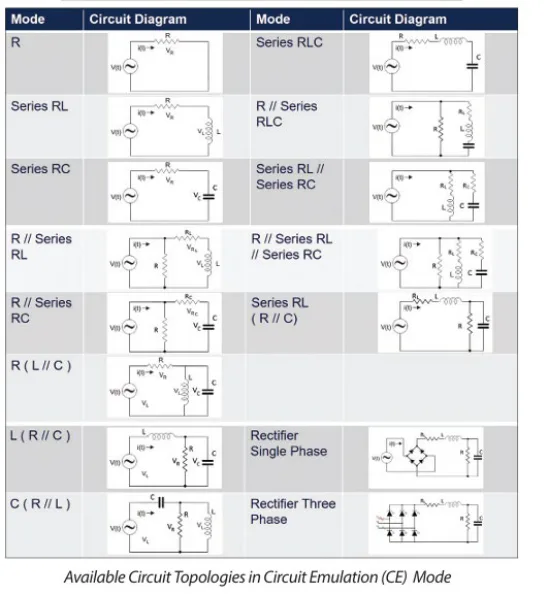
The anti-islanding RLC load test requirement for distributed generators like PV Inverters and Bidirectional V2G EV Chargers can be programmed on the ELZ in CE mode using the “R // Series RL, Series RC” circuit setting. This eliminates the need for switchable L, R and C load banks to meet this requirement.
Why is Circuit Emulation (CE) technically difficult to accomplish?
Circuit emulation in power electronics is technically complicated to achieve because it requires real-time simulation, precise power regulation and robust system-level design . Few test systems combine all three successfully, which is why high-performance load emulation is often a premium feature in advanced power hardware.
| CE Challenge | What It Requires |
|---|---|
| Real-Time Response | Emulating dynamic RLC behavior requiressub-millisecond control loops (often in the k Hz range orfaster).Fast current injection to track dynamic load behavior. Delays or overshoots in the control loop candestabilize the emulated circuit. |
| Accurate RLC Modeling | Real-time differential equation solving withhigh-speed numerical integration. To maintain accuracywithout numerical instability, the models must be finely tuned and run at high sampling rates. |
| Precision Power Control | High-fidelity voltage/current control with four-quadrant operation and low ripple. |
| Advanced Control Architecture | Requires powerful DSPs or real-time processorsto maintain tight control loops. Must run concurrenttasks with low jitter. (e.g., control tasks, waveform synthesis, fault detection, and safety mechanisms) |
| Stability in Complex Conditions | Robust controlof resonant and unstable circuits without inducing oscillations. |
| Wide Operating Range | Consistent performance across varied voltage, current, and frequency domains. For example, emulating alow-Q LC circuit at both 50 Hz and 5 k Hz places very different demands on the system. |
| Calibration &Validation | Verification against real-world circuits foraccuracy and repeatability. |
Figure 1 Table of Circuit Emulation Technical Requirements
Introducing the ELZ Regenerative Load with 15 Circuit Emulation Topologies
Circuit Emulation (CE) mode is a proprietary load operating mode of the ELZ Series AC & DC Source/Load unit and builds on the Constant Current mode as well by allowing the user to select from a wide range of linear circuit topologies and set values for the various R, L and C parameters of each circuit. The ELZ goes far beyond the functions of a conventional load — it transforms into a versatile, programmable emulator for linear and rectifier circuits, empowering users to easily define a wide range of R, L, and C values across multiple circuit topologies. This flexibility opens the door to innovative testing
Delivering high-fidelity circuit emulation in a regenerative load like the ELZ is not trivial. Here’s why it stands out:
4-Quadrant, High-Fidelity Power Control
Backed by a four-quadrant power stage, the ELZ supports smooth sourcing and sinking of power with minimal distortion.
Stability Across Edge Cases
The ELZ is engineered to handle resonant, unstable, or nonlinear circuit behaviors without losing control or introducing error.
Real-Time Control & Fast Response Time
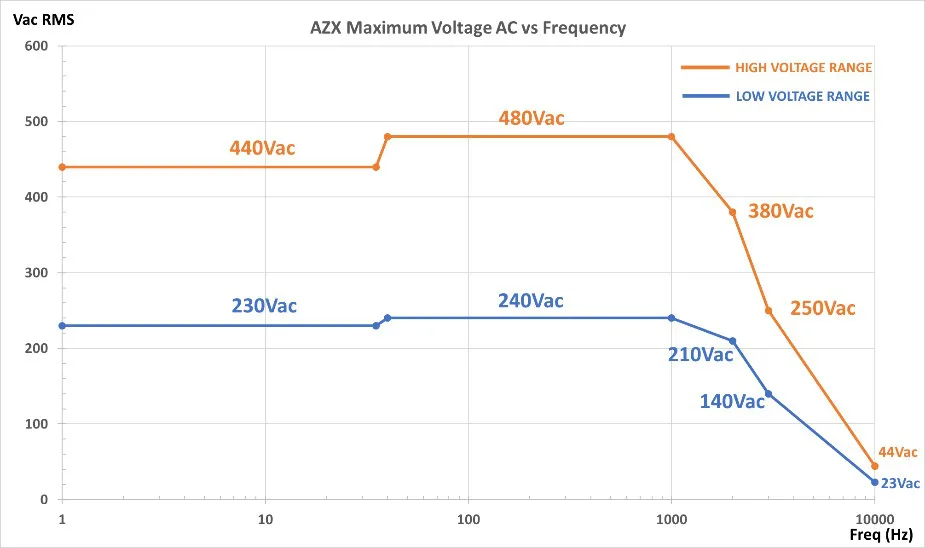
The ELZ features ultra-fast control loops that operate up to 10kHz , enabling it to respond quickly to changes in voltage or current. This is essential for accurately simulating reactive circuit behavior with minimal lag and no instability.
Accurate, High-Resolution Circuit Modeling
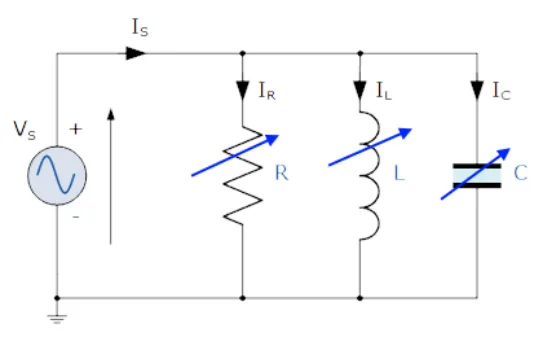
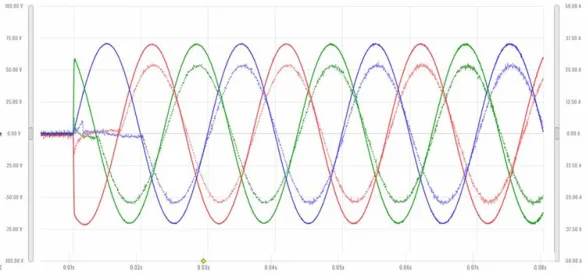
The ELZ Series continuously adjusts for RLC load behavior using high speed sampling and advanced DSPs for repeatable results. This unit has an advanced scope with a high sample rate up to 500Ks/s.
Fast sync and high impedance mode
Quick frequency sync acquisition during load test is ideal for testing contactors. Fast sync reconnects the load within a short period of time. A programmable load is recommended over resistive loads to achieve this.
Test Smarter with Built-In CE Capability
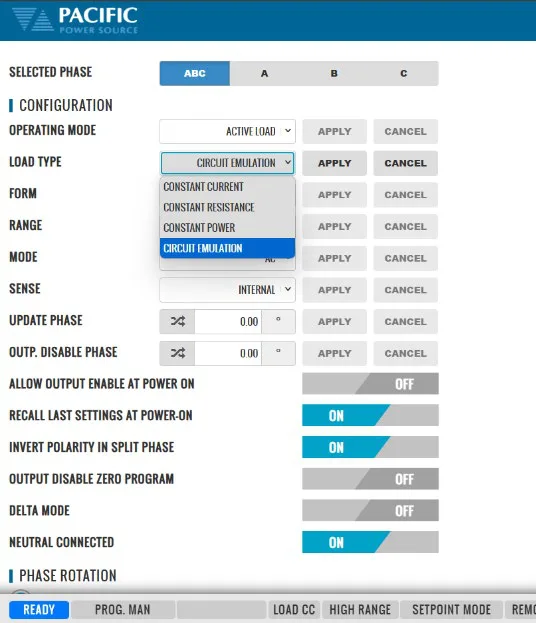
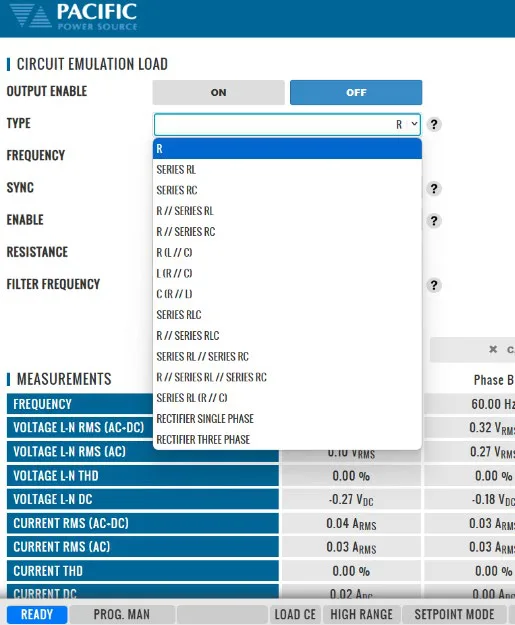
You have the option to control the load mode through the front control panel Or with the built-in SmartSource Suite Remote Control Platform via any web-browser. Easily select the Active Load Type as ‘Circuit Emulation’ and choose from 15 different types of typologies.
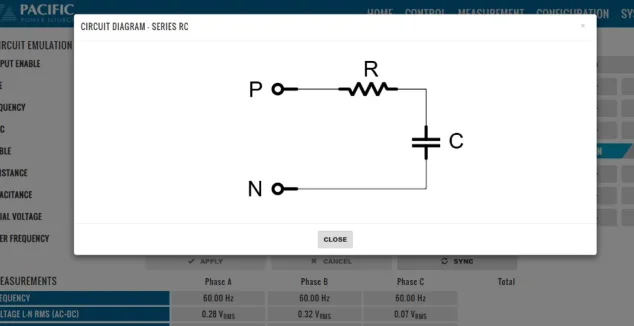
Before choosing the typology, you can see a preview of the configuration to make testing easy.
- No additional equipment required
- Change modes easily without having to turn the unit on/off.
- Easily select from 15 typologies, get a preview diagram, and select the load mode.
What is a circuit emulation load?
A circuit emulation load is a programmable electronic load that reproduces the electrical behavior of a specified circuit or impedance. Depending on the equipment, the load can emulate resistive (R), inductive (L), capacitive (C), or combined RLC characteristics.
Circuit emulation allows engineers to reproduce different electrical conditions without assembling physical load components for every test. This approach is particularly useful for inverter, converter, DER, and grid-interactive equipment testing.
How is circuit emulation and RLC Load Emulation used for anti-islanding testing?
Circuit emulation is used in anti-islanding testing to reproduce the RLC load conditions required to evaluate an inverter’s islanding detection and disconnection behavior.
During an anti-islanding test, the grid-connected DER is operated with a controlled load. The RLC load can be adjusted to create a near-balanced condition between generated and consumed real and reactive power. The simulated grid is then disconnected, creating an islanding condition, and the test system measures whether and how quickly the DER detects the condition and ceases energizing the grid.
Programmable RLC load emulation can simplify this process by allowing the required load conditions to be configured electronically rather than using manually configured resistor, inductor, and capacitor banks.
What standards require anti-islanding testing?
Anti-islanding requirements depend on the equipment, application, jurisdiction, and applicable grid-interconnection requirements. Standards and requirements commonly associated with inverter and distributed energy resource testing include IEEE 1547/1547.1, UL 1741, and IEC 62116.
UL Solutions identifies UL 1741 and IEEE 1547 among the key standards used for distributed energy resource and inverter testing.
The applicable test procedure and parameters should always be determined from the specific certification standard, grid code, and test plan for the product being evaluated.
SUMMARY
The ELZ Series Regenerative Load isn’t just a programmable load—it’s a platform for several emulation modes including advanced circuit emulation. Circuit emulation is a powerful tool for engineers who need precision, flexibility, and control in their testing process. Learn how the ELZ Series can elevate your testing strategy with real-time circuit emulation mode.
Loading capability is also available on the AZX Series All-in-1 AC/DC Power Source , and GSZ Series Regenerative Grid Simulator . For additional information, please contact sales@pacificpower.com.
Expert Help You Can Trust
Don’t know where to start? That’s what our technical customer service
experts are here for.