ITIC Curve Testing Explained: Grid Simulator and AC Power Source Requirements for Data Center Power Validation

AI server racks are pulling more current from less predictable grids than the data center industry has ever had to plan for. As AI and hyperscale builds push into areas with thinner grid infrastructure, server power supplies must ride through voltage sags, surges, and outages that would have been rare a decade ago. The ITIC Curve is the industry benchmark for proving a power supply can take that punishment without dropping load — and testing against it takes a source that can generate those disturbances on demand, safely and repeatably.
What Is the ITIC Curve?
The ITIC Curve (Information Technology Industry Council Curve, formerly known as CBEMA), published in 2000, is a voltage-tolerance envelope defining how far and how long an AC disturbance can deviate from nominal grid voltages before IT equipment can be expected to malfunction or be damaged. It has three zones: a Prohibited Region (surges risking damage), a No Interruption in Function Region (the safe operating zone), and a No Damage Region (deeper sags/interruptions unlikely to cause damage even with brief function loss).
ITI (CBEMA) Curve
(Revised 2000)
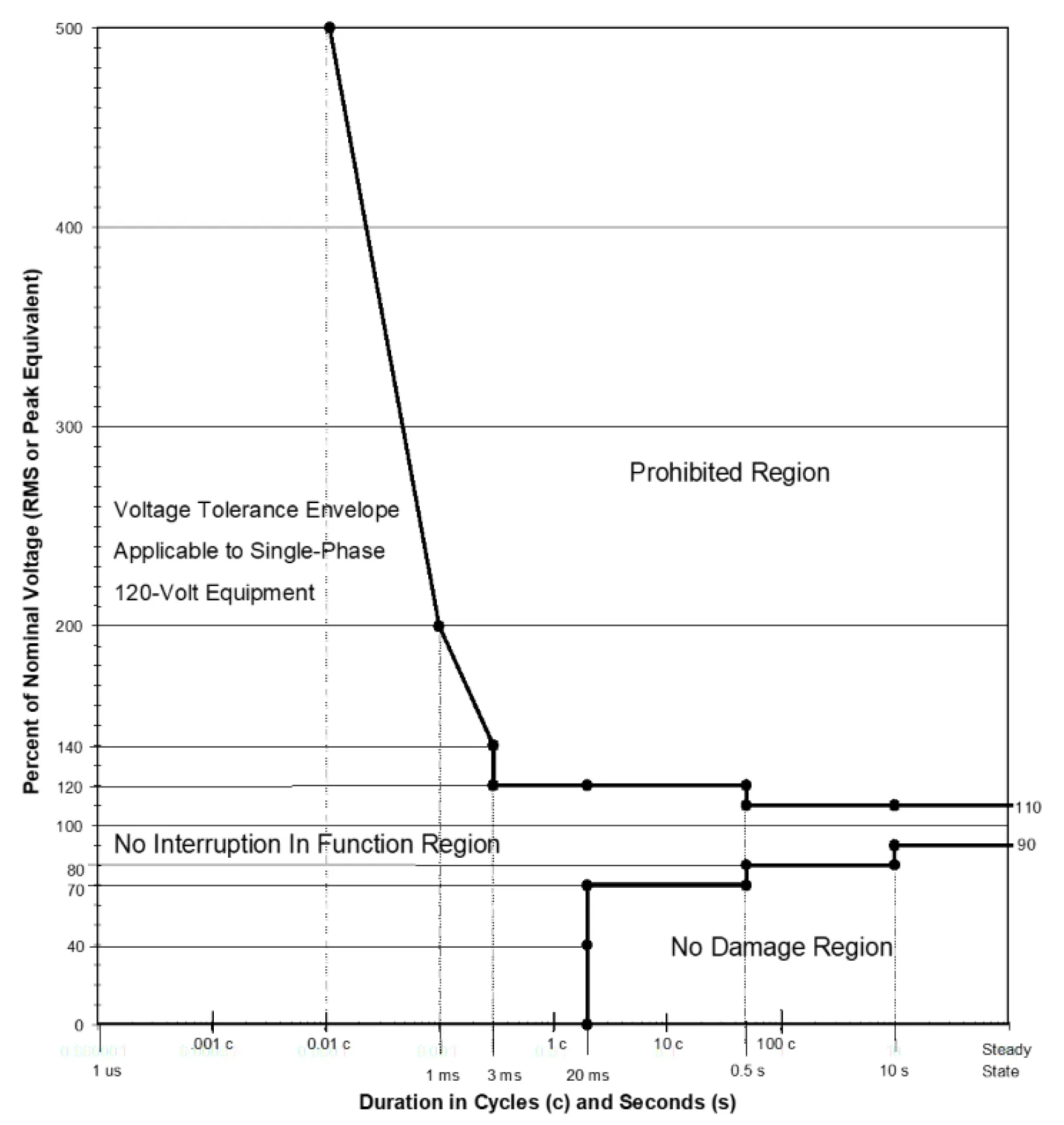
Key ITIC Reference Points
| Disturbance Type | Voltage Level | Max Duration |
|---|---|---|
| Steady-state tolerance | ±10% of nominal | Continuous |
| Voltage swell | Up to 120% RMS | 0.5 sec |
| Voltage sag | Down to 70% RMS | 0.5 sec (30 cycles) |
| Voltage sag (shallow) | Down to 80% RMS | 10 sec |
| Dropout / interruption | 0% | Up to ~20 ms |
| Decaying ringwave transient | 140–200% of peak | Sub-cycle |
Note: Real-world events often exceed the curve’s upper boundary — utility switching transients and generator/UPS transfers can spike well past 120–200%. Test sources need to reach into that prohibited-region territory, not just run the standard sag/swell/dropout sequence.
Why It Matters More for AI-Era Data Centers
- Grid strain from AI workloads — dense GPU/accelerator loads stress both the utility feed and backup infrastructure
- Weaker grids at the edge — sites chosen for land and power availability often see less consistent incoming power quality
- Backup transitions are disturbance events — every utility/UPS/generator transfer is a voltage event the PSU must ride through cleanly
Applying a Grid Simulator to ITIC Sequences
ITIC qualification is a sequence of programmed voltage events applied to a live PSU or power shelf while monitoring for shutdown, reset, or output voltage droop. The source needs to program precise magnitude/duration steps synced to the AC waveform, push short-duration high-magnitude events into the prohibited region for margin testing, and recover cleanly across single-, split-, and three-phase configurations at real rack power levels. A regenerative grid simulator does this natively — and returns unused energy to the grid instead of dissipating it as heat.
How Pacific Power Source Approaches ITIC Curve Testing
- RGS Series Regenerative Grid Simulator — 2-in-1 grid simulator with optional 4-quadrant AC/DC load, ~12 kVA up to 1.296 MVA+, with a 200 µs-resolution digitizer/scope built in to capture sub-millisecond ITIC test related events precisely.
- GSZ Series Regenerative Grid Simulator with PHIL — combines ITIC-style transients with real-time grid modeling; 30 kVA/kW blocks, parallelable to 550 kVA/kW, with higher-power systems up to 1.1 MW+.
- AGX Series All-in-1 Regenerative AC/DC Source — AC source, DC supply, current source, AC/DC load, and PHIL interface in one chassis; up to 24 kW per 4U, 6 kVA to 1.296 MVA+ overall.
- SmartSource Suite — browser-based control platform for building and running full ITIC sequences (sag, swell, dropout, ringwave, custom waveform) with repeatable precision.
Phase-to-phase and channel-to-channel galvanic isolation also enables asymmetric, phase-imbalanced disturbance tests — closer to real utility fault behavior — and the same platform scales from bench-level kVA to full rack validation without switching test systems mid-program.
Beyond the ITIC Curve
Pacific Power Source also covers the rest of a data center power quality plan: harmonics and flicker compliance (ECTS2 Series, 750 VA–110 kVA), voltage dips and short interruptions (EPTS Series, up to 100 A/phase), and BBU/energy storage validation for the DC side of the chain.
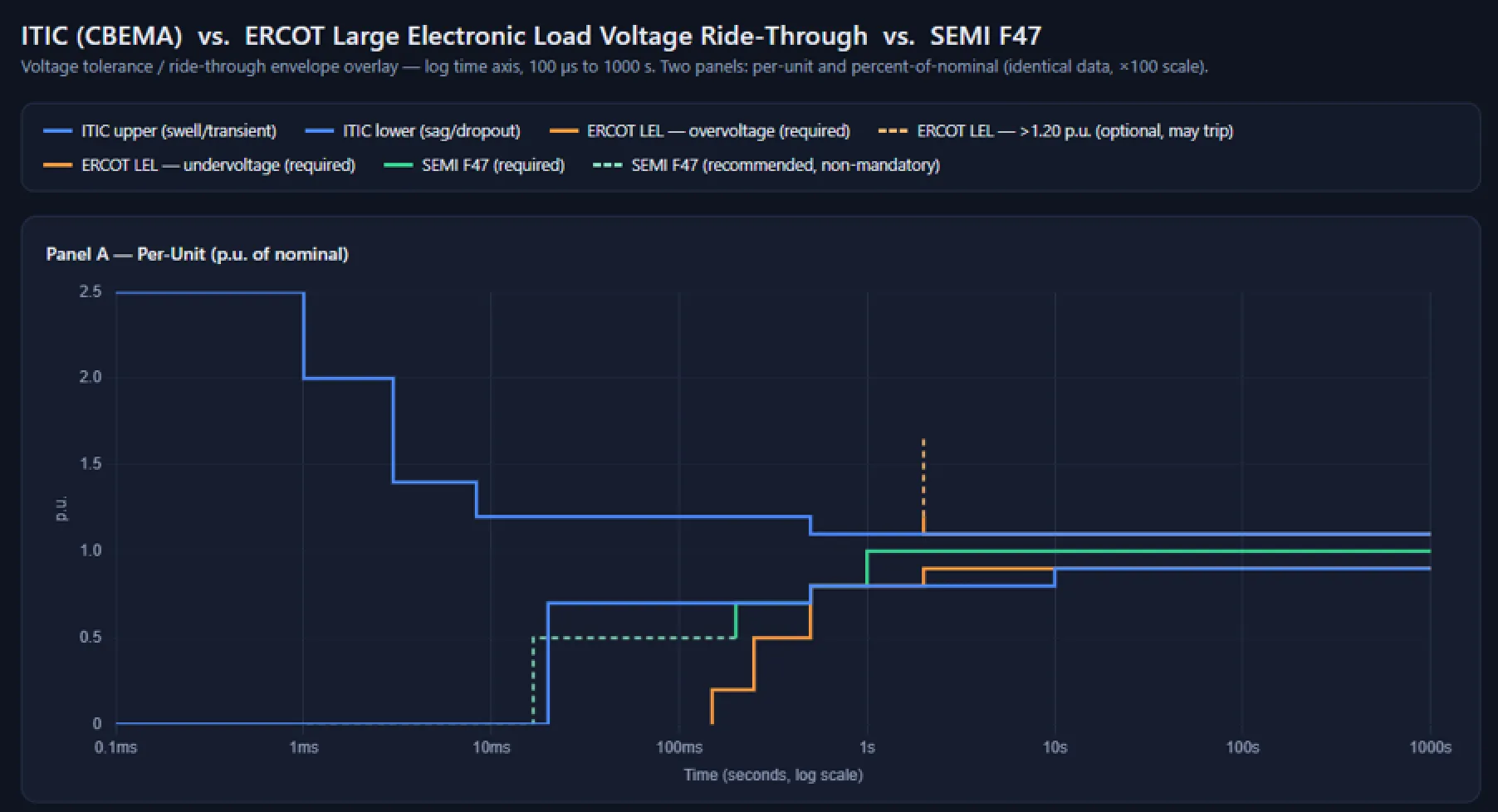
The image overlays the AC grid immunity test levels and duration requirements for three different industry standards: the ITIC Curve (formerly known as the CBEMA Curve), the ERCOT LEL, and SEMI F47. Different colors are used to clearly distinguish the limits defined by each standard. Although there are significant differences in voltage levels and allowable durations among the three standards, the overlay clearly illustrates the common concept: applying abnormal AC voltage conditions for specified durations to verify equipment immunity to voltage sags, interruptions, and surges.
Talk to a Power Test Applications Engineer
Building an ITIC test plan for AI server PSUs, power shelves, or rack-level PDUs? Our applications engineers can help spec the right grid simulator configuration, from bench testing to megawatt-class rack validation. Explore our Data Center Power Test Solutions or contact our sales team.
FAQ
What is the ITIC Curve used for?
It defines the voltage tolerance envelope for IT and server equipment — how large a sag, swell, or interruption a power supply must ride through without malfunctioning or being damaged.
How is ITIC Curve testing performed?
A programmed sequence of sags, swells, dropouts, and transients is applied to the PSU's AC input while monitoring for droop, reset, or shutdown at each step. Pacific Power Source's RGS and GSZ Series regenerative grid simulators generate these sequences natively, with SmartSource Suite handling the programming and sequencing.
What equipment is needed?
A programmable AC source or regenerative grid simulator with precise, fast voltage-magnitude and duration control, plus measurement instrumentation to verify each event and the DUT's response — the role Pacific Power Source's RGS, GSZ, and AGX Series platforms are built to fill at power levels from bench-scale up to megawatt-class rack testing.
Is ITIC Curve testing required for data centers?
It's not a mandatory regulatory standard, but it's a widely adopted industry benchmark for qualifying reliable operation on real-world, unstable grid power.
How does the ITIC Curve differ from SEMI F47?
ITIC covers general IT/server equipment voltage tolerance; SEMI F47 is specific to voltage sag ride-through for semiconductor processing equipment.
Expert Help You Can Trust
Don’t know where to start? That’s what our technical customer service
experts are here for.